China Weather in February: What Travelers Should Expect
- 1872113757
- 3 days ago
- 3 min read
China Weather in February: What Travelers Should Expect
February in China straddles deep winter and early spring. From snowy northern cities to mild southern valleys, travelers can experience dramatically different climates within a single trip. Here’s a regional breakdown of what to expect and how to plan.
Key Takeaways
China in February offers multiple climates within one trip, from icy north to mild south.
Northern regions remain extremely cold, with snow, ice, and strong winds.
Central & eastern cities are cold but manageable; layers and windproof outerwear are useful.
Southwest China has the largest contrasts: Tibet is frigid, valleys like Yunnan are mild.
Southern China & coastal regions are mild, ideal for outdoor activities and avoiding winter entirely.
February sees fewer crowds, making it a flexible month for travel and photography
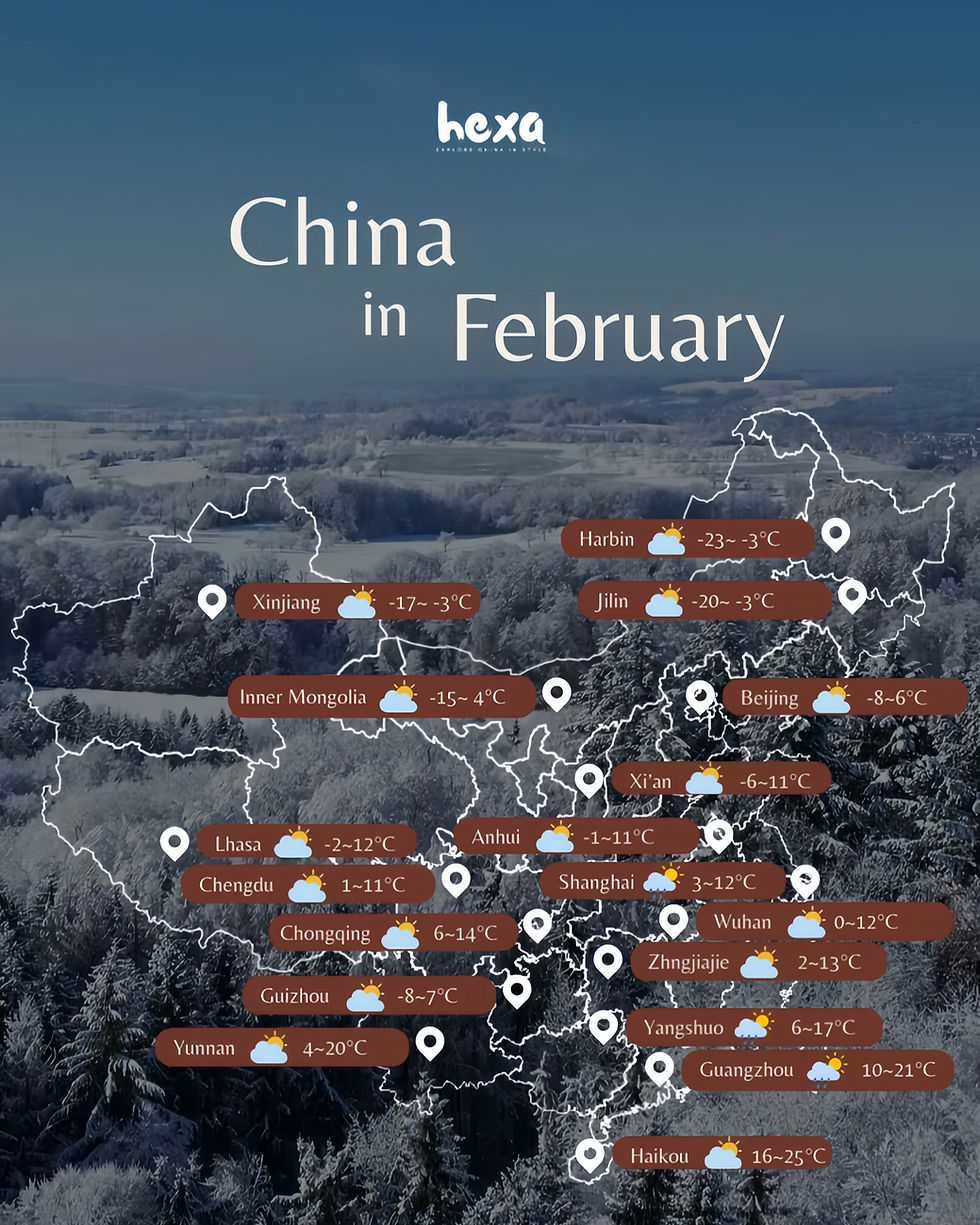
Northern & Northeastern China
Harbin · Jilin · Beijing · Inner Mongolia · Xinjiang
Temperature: −25°C to 5°C
Conditions: Snow and ice dominate; strong winds make temperatures feel colder; mostly clear skies between snow events.
Precipitation: Frequent snow in Heilongjiang and Jilin, snow cover common.
Northern China remains firmly in winter. Snow blankets cities and rivers, and frigid wind chills are frequent. Outdoor activities are limited but winter festivals and ice photography are highlights.
What to wear: Layered thermal clothing is essential. A heavy down jacket, insulated boots, thick gloves, hat, and scarves will protect against wind and frost. Consider windproof outer layers for exposed areas.
Central & Eastern China
Xi’an · Anhui · Shanghai · Wuhan
Temperature: −3°C to 12°C
Conditions: Cold mornings and evenings, milder afternoons, occasional damp days.
Precipitation: Light rain or drizzle is possible; snowfall rare in lowlands.
Central and eastern cities see a softening of winter. Historical sites and museums can be enjoyed with fewer crowds. Cloudy, damp days occasionally make mornings feel chillier.
What to wear: A medium-weight coat over sweaters or fleece layers works well. Comfortable walking shoes, scarves, and removable layers help adapt to changing daily temperatures.
Southwest China
Lhasa · Chengdu · Chongqing · Yunnan
Temperature: −20°C (Tibet) to 20°C (Yunnan)
Conditions: High-altitude Tibet is sunny but cold; Chengdu and Chongqing are cool and humid; Yunnan enjoys mild, mostly dry weather.
Precipitation: Light rain in Sichuan valleys; snow persists on the plateau.
Southwest China shows the largest contrasts. Plateau regions remain very cold, while lower valleys offer some of the year’s most comfortable conditions.
What to wear: Full winter gear for high-altitude areas. In valleys like Yunnan, layered clothing with a light waterproof jacket is ideal to adjust for morning chill and warmer afternoons.
Southern China & Coastal Regions
Guangzhou · Yangshuo · Haikou · Hainan
Temperature: 10°C to 25°C
Conditions: Mild days and cooler evenings; occasional light showers; little cold stress.
Precipitation: Low overall; humidity higher than inland regions.
Southern China already feels like spring, perfect for outdoor exploration, river towns, and coastal walks.
What to wear: Breathable layers with a light jacket or hoodie for mornings and evenings. In Hainan, short sleeves or shorts are comfortable during the day, with a light top for coastal breezes.

February 2026 offers a clear seasonal contrast across China. Snow and deep cold dominate the north, central and eastern regions are manageable with layering, southwest combines highland chill with valley mildness, and southern coasts approach spring. Proper clothing and regional planning allow travelers to enjoy both winter scenery and mild outdoor excursions in one trip.


Comments